Volume 1. Notes from the Room.
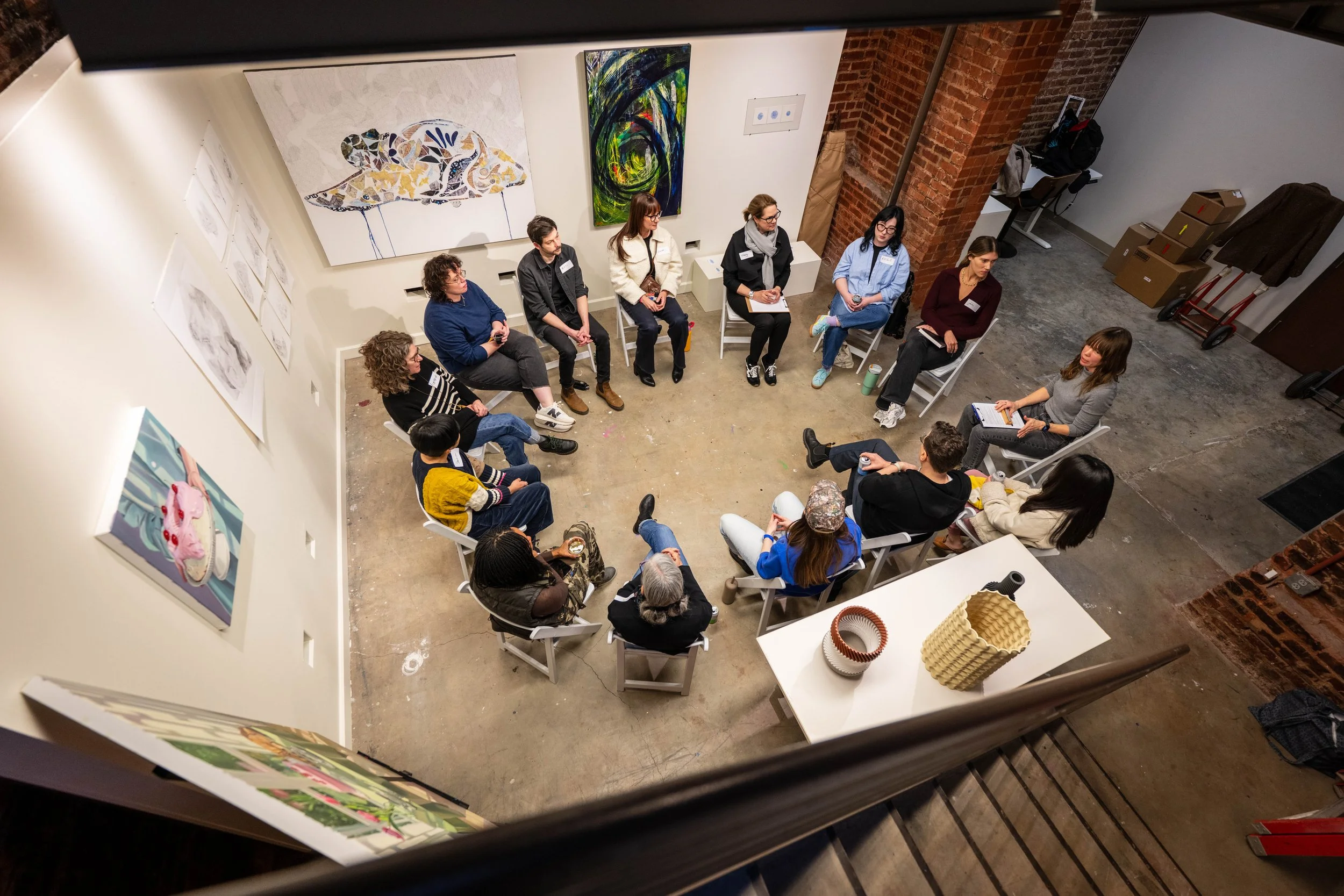
There is a particular kind of discomfort that happens in a good critique. Not the discomfort of being criticized, but the discomfort of having someone point to the thing you already knew wasn't working, or the thing you were hoping no one would notice. That is actually where the most useful conversations begin.
The thing you are hiding is often the most interesting thing.
Misregistration. A glitch. A failed print left in the pile. A moment where the process showed itself uninvited. Across both sessions, the details artists were most uncertain about were the ones the room kept coming back to. Before you smooth something over, ask whether it is worth keeping.
Control is a dial, not a switch.
Several artists were working with tools or processes they could not fully predict. New technology, new scale, unfamiliar materials. The instinct is to either master the process completely or abandon it. The more interesting option is to decide deliberately how much control to hold and where to let go, and to make that negotiation visible in the work.
If someone wants to touch it, that is information.
Wanting to touch a piece, wanting to walk into it, wanting to be surrounded by it. These responses came up repeatedly and they were not casual. They were signals about what the work was actually asking for. Scale, installation, and the physical relationship between work and viewer are not afterthoughts. They are part of the work.
The room always finds it.
Every piece has one. It is the detail drawing attention for the wrong reasons, the small thing pulling focus away from everything else. Sometimes it is literal. Sometimes it is a color, a corner, a compositional decision made early and never revisited. The room will find it. It is worth finding it yourself first.
You do not need to explain it before you make it.
Some of the most compelling work in these sessions came from artists working toward a feeling they could not yet put into words. A confusion, a tension, a question they were living inside. The work was the attempt to reach something that resisted language. That is a legitimate reason to make something.
