Volume 6. Notes from the Room.
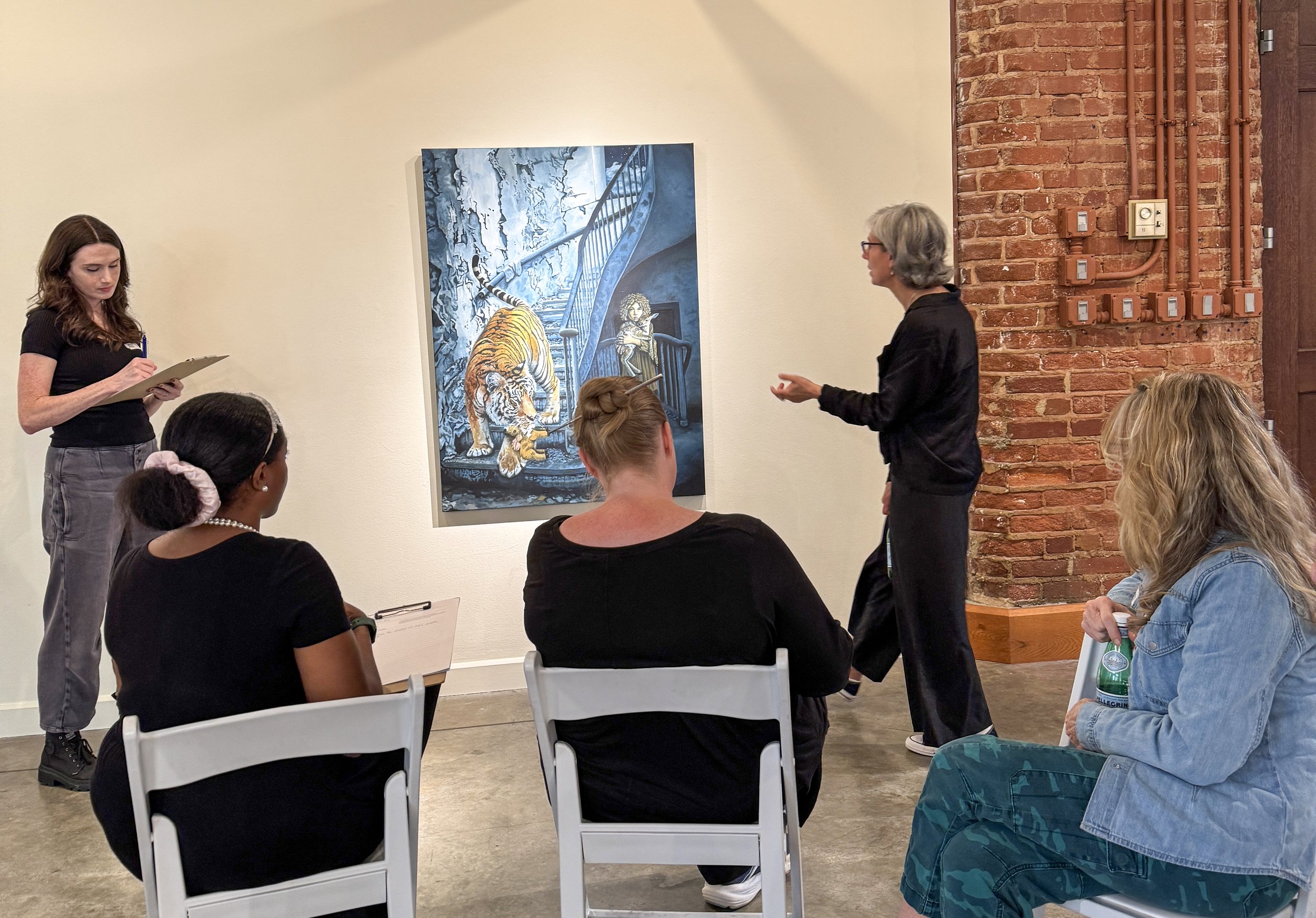
Our most recent Comment Thread session featured a range of work. Some artists brought individual objects, others brought a series. Some of the work was new, and some had been in progress a long time. Here are three things from it worth bringing back to the studio.
Not every piece in the series needs to be the same size.
The instinct in a series is to make everything the same size for the sake of unity. But size shapes how a viewer's body relates to a piece, and different pieces can be asking for different relationships. In this session some images wanted to be large enough to surround you, and others wanted to be small enough that you had to lean in close. One artist noted that a few of hers should be very small, because that is how small the moment felt. If everything in a series is the same size, that should be a choice and not a default.
The piece you haven't solved might be the best one to bring.
There is a strong pull to only show work you have already figured out. But some of the most useful critiques this session were of pieces the artist openly had not resolved. One artist brought a body of work specifically because she did not know how to present it, and left with a direction she had not considered. An unresolved piece gives the room something real to push on, and the conversation tends to be more specific because of it. If there is a piece you have not cracked yet, that might be the one to bring.
You only get to hear the uninfluenced reaction once.
When the room learns the story behind a piece, the response shifts. That is not a problem, and the second read is not less honest than the first. What matters is how far it moves. If the read barely changes, the work is carrying its meaning on its own. If it changes completely, the work is leaning on context that a viewer in a gallery will not have, because you will not be there to explain it. This session was the second case. That gap is the information. It tells you whether to build the context into the work itself, through the title, the materials, the scale, the way it is shown, or to accept that the cold version is what most people will get.
